
Back in July, our inaugural post asked whether we should party like it’s 1999. At the time, SpaceX had just listed and Anthropic and OpenAI were still rumors on the horizon. Four months later, one of those rumors has a ticker. Anthropic, the company behind the Claude AI models, launched its IPO roadshow on November 10 and plans to trade on the Nasdaq under the symbol “ANT.”
We’ve already fielded a handful of questions: Should I try to get shares? Do I already own it? Is this the top? I’ll try to answer the first two and politely dodge the third. The goal here isn’t to tell you to buy or pass. It’s to walk through what’s being offered, why the price tag is so large, what could go wrong, and how this stock may end up in your portfolio whether you go looking for it or not.
What’s on the menu?
Here are the basics, per Anthropic’s roadshow announcement and its amended filing:
| Item |
Detail |
| Ticker / exchange |
ANT on the Nasdaq Global Select Market |
| Expected price range |
$70 to $78 per share |
| Shares offered |
825 million (about 801 million new shares from Anthropic, about 24 million from existing holders), plus a 123.75 million share underwriter option |
| Money raised |
Roughly $58 to $64 billion, before the underwriter option |
| Implied market cap |
About $916 billion to $1.02 trillion on shares outstanding; up to about $1.4 trillion fully diluted |
| Expected timing |
Reported pricing on November 18, trading on November 19 |
Two details are worth a quick note. First, seven of Anthropic’s suppliers and partners, including Google and Nvidia, have agreed to buy about $26 billion of non-voting stock at the IPO price alongside the deal. Second, CNBC reported that roughly 20% of shares may be set aside for individual investors, well above the norm. That may mean more of you see an option to request shares through a brokerage account.
Why two valuations? The lower figure counts shares that exist today. The higher, fully diluted figure also counts stock options and other equity awards that could become shares later. Both are fair ways to look at it, and you’ll see both in the headlines.
Where does that fit? At roughly $1 trillion, ANT would land somewhere around 11th or 12th among U.S. public companies, in the neighborhood of Berkshire Hathaway and Walmart. On a fully diluted basis, it would sit closer to Tesla, Broadcom, and Meta, just inside the top ten (in short, a very large business). For perspective, Anthropic’s last private funding round in May valued it at about $965 billion. Earlier this fall, some reports floated $2 trillion. The range came in well below that after a rough few weeks for AI stocks, which says something about how quickly sentiment can shift.
Why the big number?
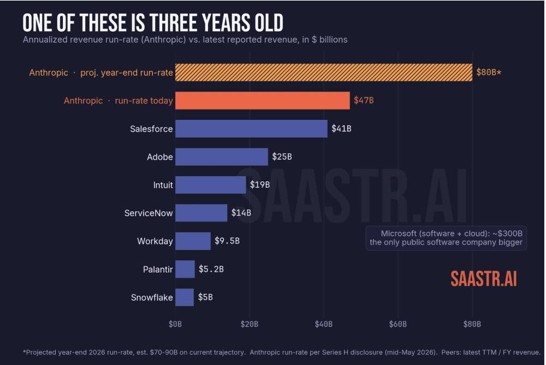
The short answer is revenue growth that, frankly, doesn’t look like anything we’ve seen from a company this size. A few highlights from the S-1 (the prospectus every company files before going public):
- Revenue went from about $386 million in 2024 to $4.6 billion in 2025, roughly 12x in a single year.
- It kept going in 2026. Revenue was $16.3 billion in the first half of the year, about 14x the same period in 2025, and $33.2 billion through September.
- Margins improved as it scaled. Revenue grew far faster than the cost of serving customers, and the company posted its first quarterly operating profit in Q2 2026.
What’s driving it? Mostly businesses (you’ll hear this sometimes referred to as “enterprise” customers). Companies are paying to use AI for coding, customer service, research, and a growing list of everyday tasks, and many are spending more each quarter as they find new uses. Demand for AI computing power has been so strong that Anthropic says it has at times asked for more capacity than its cloud partners could provide.
Investors at a $1 trillion-plus valuation aren’t paying for today’s results. They’re paying for where they think revenue goes from here. Anthropic itself cautions in the S-1 that it expects its growth rate to decline, possibly faster than anticipated, as the business gets bigger and the market matures. Growing 12x is a lot easier from $386 million than from $40 billion.
What could go wrong?
Plenty, and to its credit, the S-1 says so at length. When reading through the prospectus, these risk factors take up a disproportionate amount of the document. Three stood out to us.
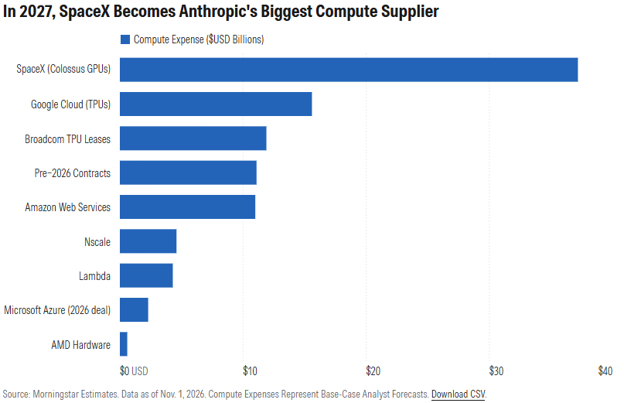
The bills are already signed. Anthropic’s biggest obligation isn’t traditional debt. It’s the computing power it has contracted to buy from cloud and chip partners, typically 12 to 18 months before it arrives. The latest filing puts total commitments at about $900 billion, mostly for compute and infrastructure, with about $71 billion due in the next 12 months. That’s a bet that revenue keeps growing into the capacity. If demand cools, the costs stay locked in while the revenue doesn’t. Anthropic also has about $6.2 billion of convertible notes outstanding to Amazon.
Competition and pricing power. OpenAI, Google, Microsoft, and a growing list of others are chasing the same customers. Much of Anthropic’s revenue is usage-based, so customers can shift spending without breaking a long contract. Prices for AI also tend to fall as models improve. Anthropic says its newest model cut customers’ cost per task by about 40% versus the prior version while protecting its own margins. That’s a good outcome when it works. It also shows how quickly the price of the product can move.
Regulation and governance. AI rules are still being written in the U.S. and abroad. Anthropic is also challenging in court a federal “supply-chain risk” designation that followed a dispute with the Department of War, and the S-1 suggests its safety commitments may at times come at shareholders’ expense. Finally, this won’t be a typical shareholder setup. Anthropic is a public benefit corporation, and its founders and a separate trust will control most of the voting power. Buyers of Class A shares will have limited say in major decisions.
You may already be in line.
In July, I mentioned that index providers were adjusting their rules to accommodate these mega-IPOs. SpaceX was the test case. ANT looks set to follow the same path.
Nasdaq 100 (think QQQ). Before this year, a new listing generally had to trade for at least three full months before joining the Nasdaq 100. Under rules effective May 1, 2026, a newly listed company that ranks in the index’s top 40 by market cap can be added after just 15 trading days. At roughly $1 trillion, ANT would clear that bar easily, which puts a potential addition in mid-December if it trades on November 19 as expected.
The weighting is where it gets nuanced. Only about 6% of Anthropic’s shares will trade publicly at first. Nasdaq sets a new company’s weight at the lesser of its total market cap or three times the value of its publicly traded shares. So, ANT would likely enter at a meaningful but modest weight, and that weight could grow as insider lockups expire. For reference, SpaceX entered at about 1.3%.
Other broad indexes. FTSE Russell added a fast-entry rule that lets large IPOs in after five days, and CRSP (the index behind many Vanguard funds) eased its float requirements. Total-market funds may pick up ANT relatively quickly, though at small weights.
S&P 500. S&P is still the holdout. It requires 12 months of trading, and its profitability test calls for positive GAAP earnings in the most recent quarter and over the most recent four quarters combined. S&P has also said a company’s size alone isn’t grounds for an exception. Anthropic reported a GAAP net loss through September, much of it a non-cash accounting charge, so S&P 500 inclusion likely isn’t a near-term event.
What that means for you. Passive investing has become a huge part of the investing market so, if ANT is added to those indexes, you may own a small slice of it without placing a single trade. That’s worth knowing before deciding whether to add more on top.
Our take.
If you’re hoping I’ll tell you whether to put in for shares, I’ll have to disappoint you again. It depends. Still sorry. But here’s how we’re thinking about it.
The case for interest. Anthropic is growing quickly, has begun to show it can earn a profit on what it sells, and sits in one of the most closely watched parts of the economy. If AI adoption keeps broadening, early public shareholders may participate in that growth. With a larger-than-usual slice reserved for individual investors, more people than usual may have the option to buy at the offer price, which historically is where most of any first-day gain has gone.
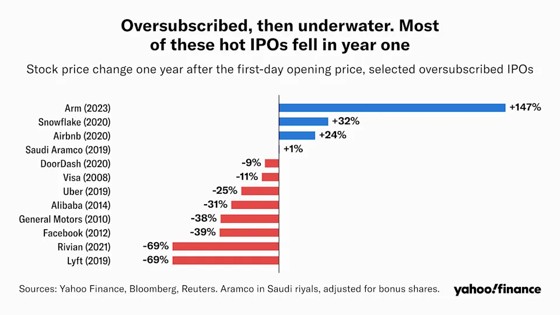
The case for patience. History isn’t kind to the average IPO buyer. Since 1980, IPOs have trailed the broader market by about 20 percentage points over their first three years. Two traits have tended to make that worse: a high price relative to sales, and a small share of the company sold to the public. Professor Jay Ritter’s data show IPOs priced above 40 times sales trailed the market by about 15% over three years. By our rough math, ANT is coming in at roughly 25 to 40 times its trailing sales, depending on which valuation you use, with only about 6% of shares trading at first. Lockup expirations over the next year will also bring more shares to market, as we’ve seen with SpaceX.
None of that means ANT will follow the averages. Averages hide a lot of very different outcomes, and a company with more than $30 billion in sales this year isn’t a typical IPO. But a high starting valuation means a lot of good news is already in the price. Remember, price does matter.
Where that leaves you. For many clients, the simplest answer may already be in place: if ANT joins the indexes your funds track, you’ll own a sliver of it at a weight that reflects its size. Anything beyond that, whether requesting IPO shares, buying after it trades, or selling an indirect position, is a decision best made in the context of your risk tolerance, time horizon, and overall plan (yes, that’s another shameless plug for the Lansing Street team.) Whatever you decide, it’s good to see another company bring its story to the public markets, and we’ll be watching closely.
Disclosures
Lansing Street Advisors LLC is a registered investment adviser with the U.S. Securities and Exchange Commission (CRD #306882). You can read more about the Lansing team at www.lansingadv.com.
To the extent that content includes references to securities, those references do not constitute an offer or solicitation to buy, sell or hold such security as information is provided for educational purposes only. Articles should not be considered investment advice and the information contained within should not be relied upon in assessing whether to invest in any securities or asset classes mentioned. Articles have been prepared without regard to the individual financial circumstances and objectives of the persons who receive it. Securities discussed may not be suitable for all investors.
Please keep in mind that a company's past financial performance, including the performance of its share price, does not guarantee future results.
Material compiled by Lansing Street Advisors is based on publicly available data at the time of compilation. Lansing Street Advisors makes no warranties or representations of any kind relating to the accuracy, completeness or timeliness of the data and shall not have liability for any damages of any kind relating to the use of such data.
Material for market review represents an assessment of the market environment at a specific point in time and is not intended to be a forecast of future events or guarantee of future results.
Indices that may be included herein are unmanaged indices and one cannot directly invest in an index. Index returns do not reflect the impact of any management fees, transaction costs or expenses. The index information included herein is for illustrative purposes only.
The trademarks and service marks contained herein are the property of their respective owners.
The information presented is for educational purposes only and is not intended to make an offer or solicitation for the sale or purchase of any specific securities, investments, or investment strategies. Investments involve risk and, unless otherwise stated, are not guaranteed. Be sure to first consult with a qualified financial adviser and/or tax professional before implementing any strategy discussed herein. Past performance is not indicative of future performance.
Lansing Street Advisors may discuss and display charts, graphs, formulas which are not intended to be used by themselves to determine which securities to buy or sell, or when to buy or sell them. Such charts and graphs offer limited information and should not be used on their own to make investment decisions.
