
The Short-Term Rental Tax Loophole: What Nobody Is Telling You
Everybody Is Talking About This
In the past 90 days, about a dozen people have asked me about the short-term rental tax loophole.
Some were pitched it by a real estate investment manager. Others picked it up from their TikTok feed.
So I want to lay out what it is, how it works, and whether it's worth pursuing.
What Is It?
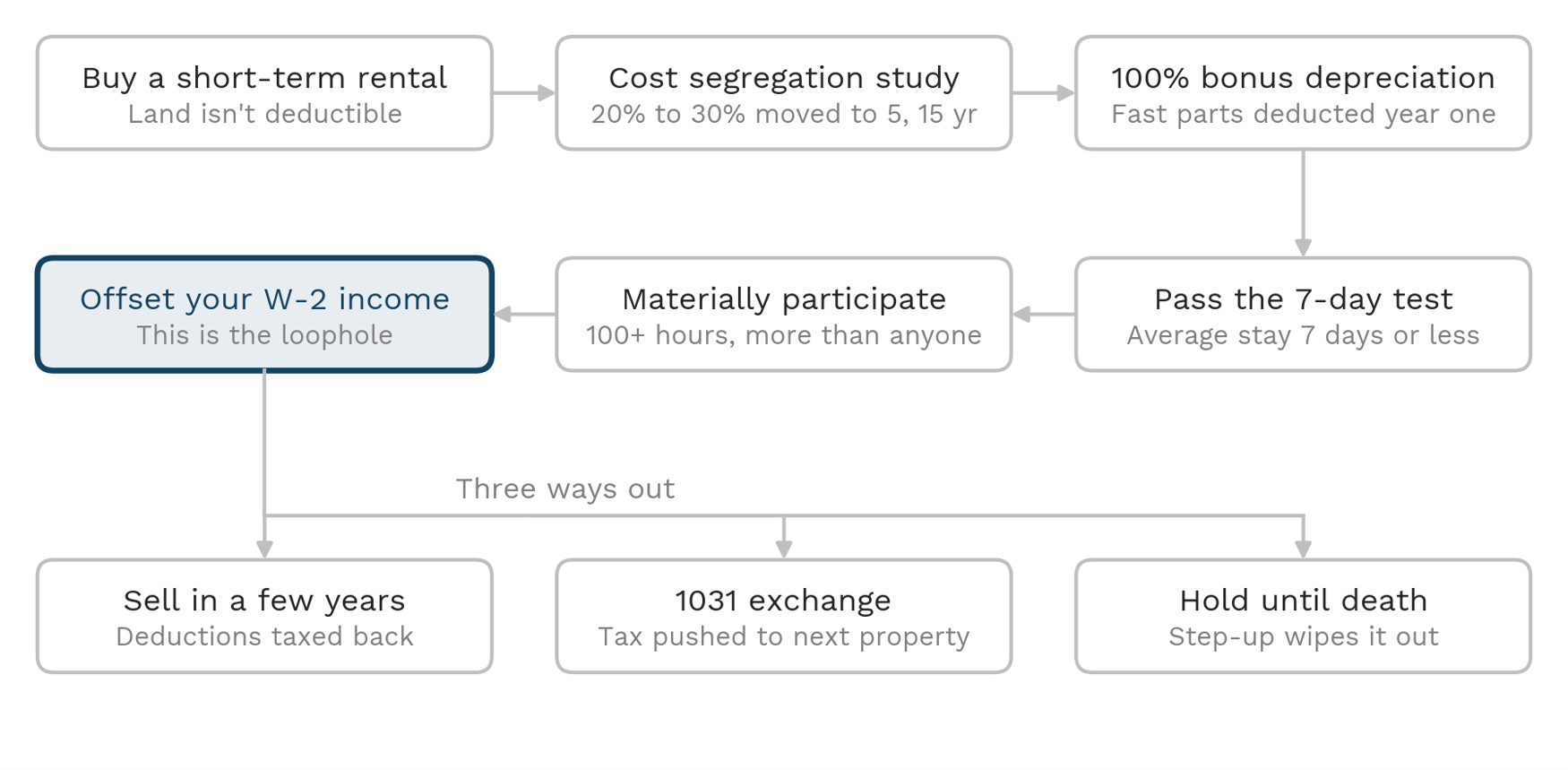
You buy a property to run as a short-term rental, think Airbnb or VRBO, where the average guest stay is 7 days or less.
A professional does a cost segregation study, breaking the building into parts like appliances, flooring, and furniture.
Those parts are usually 20% to 30% of the building's value (land doesn't count), and they can be deducted from your ordinary income in year one.
Example: buy a $500,000 property with $400,000 of building value, and you may be able to deduct about $100,000 in year 1. That could save roughly $24,000 in the 24% bracket, or up to $37,000 in the top bracket.
Nobody Is Talking About This
The big tax benefit is a one-time event. In the $500,000 example, the deduction drops to about $7,700 a year after year one.
The taxes don't just disappear. When you sell, those extra deductions are taxed again at ordinary income rates. The only ways around that are a 1031 exchange, which delays it again, or holding the property until death.
To qualify, you must spend 100+ hours on the property, and more than anyone else. If your cleaners put in 150 hours and you put in 110, you fail the test.
You have to run it like a business and keep detailed logs of the time you spend on the property.
The True Costs
Dollars
The study that sets your year 1 deduction can cost anywhere from $2,000 to $15,000.
Extra CPA fees for filing a more complicated return.
Mortgage interest, if you borrow.
Property taxes.
Insurance.
Stress
More IRS attention. A six-figure rental loss against a high W-2 income tends to get noticed.
More liability. More strangers in the house means more slip and falls, more property and casualty risk. Insurance matters.
Time
New guests every few days. Cleaning, check-ins, messages, reviews, the Airbnb or VRBO listing.
Logging your hours as you go. Taxpayers who lose in Tax Court usually lose because the log was built during the audit, not because the rule is invalid.
Actually spending 100+ hours working on the property.
Opportunity
Stock market growth. The down payment, furnishings, closing costs, and reserves could sit in a diversified index fund instead, with very little ongoing work.
Family and personal time. Guest messages, turnovers, and emergencies compete with evenings, weekends, vacations, exercise, and time with your kids.
Liquidity. Money in a property is harder and more expensive to get to. That's cash you can't use for an emergency or the next opportunity.
Diversification. A big investment in one property ties you to one location, one tourism market, and one set of local rental rules.
Is It Worth It?
To be clear, this is a real tax benefit. It's legal, and it's actually attainable. But is it the right fit for you?
If you genuinely want to spend the time and energy running this as a business, and you plan to hold the property for a very long time or pass it to your heirs, then yes, the short-term rental loophole might be worth it.
If you're looking at it for a quick tax savings, I'd think again. The time, energy, stress, and hidden costs (CPA fees, the LLC, property taxes, insurance) add up.
For perspective, $500,000 invested in the S&P 500 at the start of 2021 would have grown to about $980,000 by the end of 2025, with dividends reinvested, and no guest messages or hour logs along the way. A property can grow in value too, but a one-year tax benefit on its own shouldn't be the reason you buy one.
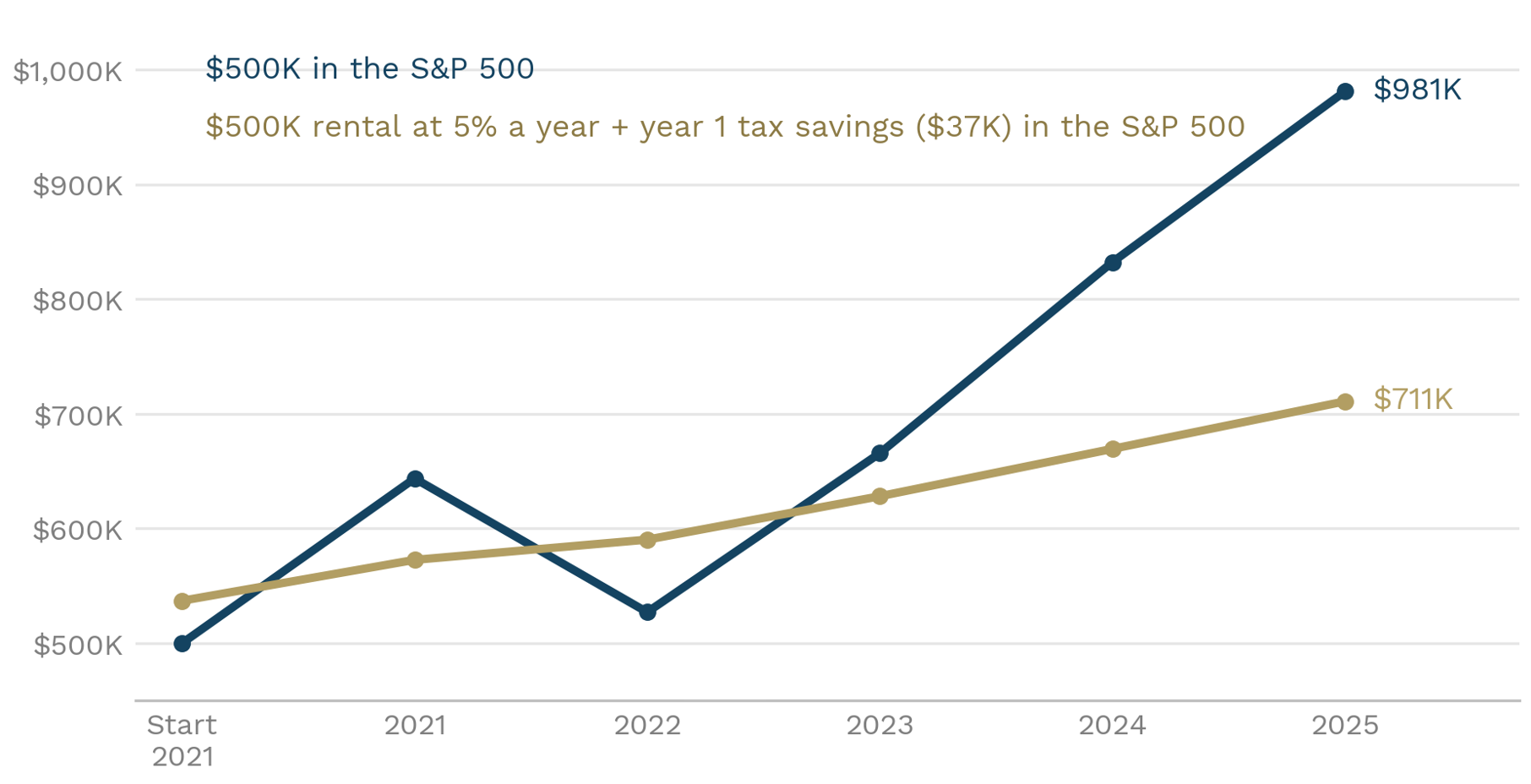
Hypothetical illustration. The S&P 500 line uses annual total returns with dividends reinvested: 28.71% (2021), -18.11% (2022), 26.29% (2023), 25.02% (2024), 17.88% (2025). The rental line assumes 5% annual appreciation on a $500,000 property, plus $37,000 of year 1 tax savings (top bracket) invested in the S&P 500. It excludes rental income, operating costs, financing, fees, and taxes owed at sale. Not a prediction of future results.
Sources
WCG CPAs, Short-Term Rental Loophole FAQ (7-day rule, material participation)
Morkel Financial, Short-Term Rental Depreciation (39 years, 20% to 30% reclassified)
Wiss, Depreciation Recapture on Real Estate (ordinary income at sale, step-up at death)
WCG CPAs, Material Participation Time Logs (hour logs)
Taxstra, Is the STR Loophole Actually Risky? (audit attention)
Rabbu / SMF Cost Segregation (study cost)
BiggerPockets, Cost Segregation FAQ (study cost)
Chartrow, S&P 500 Returns by Year (S&P 500 total returns, dividends reinvested)
Disclosures
This material is provided for educational and informational purposes only and is not intended as investment, tax, or legal advice. The information presented should not be relied upon as the sole basis for any investment, tax, or planning decision. Strategies and concepts discussed may not be suitable for all individuals; please consult with a qualified financial adviser and/or tax professional before implementing any strategy discussed herein.
Lansing Street Advisors LLC is an SEC-registered investment adviser (CRD #306882).
Lansing Street Advisors LLC does not provide tax or legal advice. The information presented should not be relied upon for tax or legal planning. Tax laws are complex and subject to change; the application of tax rules to a specific situation depends on individual circumstances. Clients should consult with a qualified tax professional and/or attorney regarding their specific situation before implementing any strategy discussed herein.
Performance figures are shown for illustrative purposes only. Past performance is not indicative of future results.
Performance data may reflect hypothetical, backtested, or model results and may not reflect actual client account performance. Hypothetical and backtested performance has inherent limitations: it does not reflect actual trading, may not reflect the impact of material economic and market factors on decision-making, and is generally prepared with the benefit of hindsight. Actual client returns will vary based on timing of contributions and withdrawals, fees, taxes, custodian costs, and other factors.
All investing involves risk including the possible loss of principal. There is no guarantee that any investment strategy will achieve its objectives.
Material compiled by Lansing Street Advisors is based on publicly available data at the time of compilation. Lansing Street Advisors makes no warranties or representations of any kind relating to the accuracy, completeness, or timeliness of the data and shall not have liability for any damages of any kind relating to the use of such data.
Charts, graphs, and formulas displayed are not intended to be used by themselves to determine which securities to buy or sell, or when to buy or sell them. Such charts and graphs offer limited information and should not be used on their own to make investment decisions.
Indices referenced are unmanaged and one cannot directly invest in an index. Index returns do not reflect management fees, transaction costs, or expenses and are shown for illustrative purposes only. Trademarks and service marks contained herein are the property of their respective owners.
