How Well Do You Play Bad?
How Well Do You Play Bad?
By Patrick Greenhalgh, Investment Advisor Rep
There is a delusion every golfer carries to the course: that we, too, could have saved par from that fairway bunker, if only the bounce had gone our way.
Golf does that to a person. It is the only game I know that can make you feel like a genius and a fraud inside of about twenty minutes.
Here is what I have come to believe after enough rounds to know better. Golf is not really a test of your swing. It is a test of you.
No matter how well you play, there is always the putt that could have dropped or the shot that just missed. The perfect round does not exist, and chasing it puts your whole temperament on display: how you handle a bad bounce, how patient you can be, whether you can stand over a three-foot putt to win the hole and not come apart. Golf is 90% mental and 10% swing away.
So is investing, and that is what this piece is really about. Golf is just the clearest mirror I have ever found for the thing that actually determines whether people reach their financial goals. It is not the thing most people think. It is not picking the winning fund or timing the market. It is temperament. Once you see the two side by side, you cannot unsee it.
The pre-shot routine
Watch a good player before a shot and you will see a routine that never changes. See the shot. Pick the target. One last look. Head down, trust the tempo, breathe, and go. All of that preparation exists for one reason. So that when it is finally time to swing, you can stop thinking and just let it happen.
Good investing works the same way, and it starts long before the market ever opens. The routine is your financial plan: what you are trying to accomplish, how long you have to do it, how much risk you can actually live with, and how your money is invested as a result. You build that plan when you are calm and thinking clearly, precisely so that you are not inventing one on the fly when markets are loud and your stomach is in your throat. A good financial decision is rarely a gut call in the moment. It is the quiet execution of a plan you already thought through.
That is the same feeling as pulling the trigger on something you have studied for weeks. The work is not the point. The work is what lets you act with a clear head when it counts and then leave the thing alone. Investors who know why they own what they own, and how each piece fits the plan, do not lie awake renegotiating that decision every time the headlines change. The ones without a plan renegotiate constantly, usually at the worst possible moment.
Here is what nobody tells you, though. The routine is not there to guarantee a perfect shot, and the plan is not there to guarantee a perfect year. Both exist so that a bad one does not rattle you into doing something you cannot take back. Which brings us to the part that actually matters.
How well do you play bad?
Anyone can play well when they are playing well. Show me a person who is striping it and I will show you a person in a good mood. A round is not defined by your best shots. It is defined by your worst ones, and by what you decide to do next.
The great ones have a gift that has nothing to do with their swing. A short memory. A double bogey on the fifth does not become a triple on the sixth, because they refuse to try the miracle recovery that turns one bad hole into a lost afternoon. They take their medicine, punch back to the fairway, and move on. They play bad well.
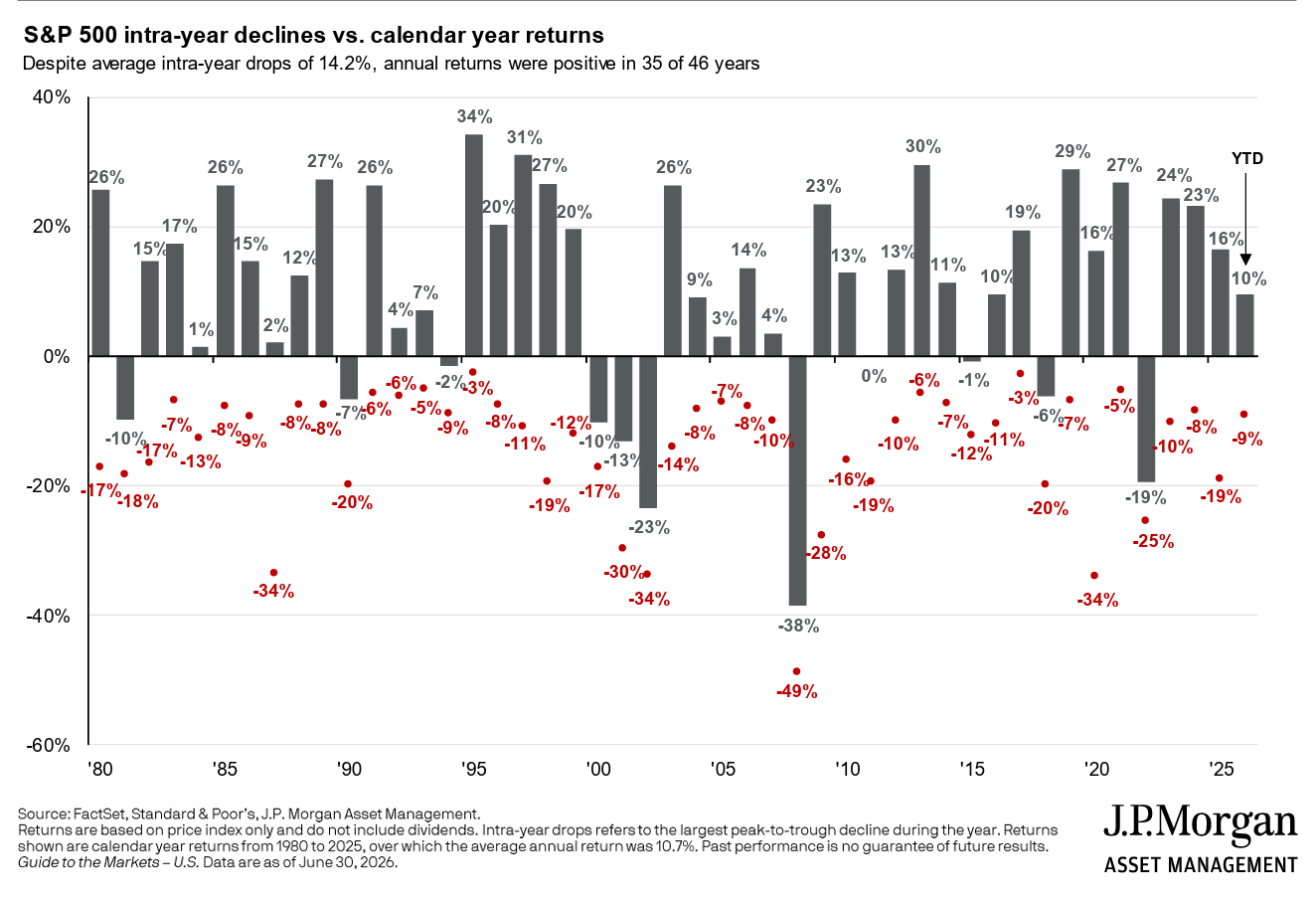
This is where real money is made and lost, and I mean that almost literally. The single biggest threat to your long-term returns is usually not the market. It is you, in the middle of a bad stretch, reaching for the miracle recovery. When markets fall, every instinct screams at you to do something: sell, get to safety, stop the bleeding. That instinct leads to the triple bogey. Selling into a decline locks in the loss, and worse, it tends to leave you on the sidelines for the recovery that follows, because the market's best days have a maddening habit of arriving right next to its worst ones.
Study after study finds the same thing. The average investor earns meaningfully less than the very funds they own.
According to Morningstar’s annual Mind the Gap study, that gap sits at roughly 1.2% per year over the past decade. While exact causes for the gap are up for debate, a big part of it comes down to behavior. It is buying after things have already run up because it finally feels safe and selling after they have fallen because it feels scary. Volatility is not a malfunction in the system. It is the admission price you pay for the returns that come from staying in your seat.
The scorecard helps a golfer stay disciplined, because the scorecard never asks how. An ugly, scrambled par counts exactly the same as a pure one. Nobody signing the card at the end cares whether it felt good. Your account statement works the same way. It does not care whether a year felt smooth or terrifying. Twenty years from now, the plan you stuck with will not show the white-knuckle moments. It will simply show that you stayed in. The real damage in investing is almost never the down market itself. It is the panic swing you take in the middle of it. The loss is not the bad break. The loss is what you do after it.
Play your own game
Every golfer knows the trap. You get paired with the long hitter, you start trying to keep up, and three holes later your own game is in pieces. The fix is old and simple. Play the course, not the other guy. And know your real handicap, the game you actually have, not the one you wish you had on your best day.
This may be the most expensive mistake in all of personal finance. Somebody at the club is up big on a stock, or a neighbor just did something clever with real estate, and suddenly a perfectly good plan feels too slow. So, you reach for more risk than you signed up for, right near the top, to catch up to someone whose full situation you do not actually know. That is trying to match the long hitter, and it wrecks portfolios the same way it wrecks rounds.
The truth that makes all of it click is that there is no single right portfolio. There is only the right portfolio for you. A thirty-five-year-old saving for a retirement three decades away and a couple retiring next year should not be playing the same shot, because their timelines and their tolerance for a bad stretch are completely different. Your plan should be built around your goals, your time horizon, and what you can genuinely stomach when things get rough, not around a benchmark, a headline, or the guy bragging in the grill room. The best portfolio in the world is worthless if you cannot stay in it, and the surest way to bail out early is to have built it for someone else's life.
Look at Rory McIlroy. He just won the Masters two years running, and he is doing it on a schedule that looks nothing like anyone else's. He plays a famously light schedule, far fewer starts than most of the tour, and says the lighter load actually helps him. While the rest of the tour grinds every week, the best player of his generation plays his own game, on his own terms, because he knows what works for him. Your money deserves that same discipline.
Every player has a caddie
Here is the part people miss. The best golfer on the planet does not walk the course alone. He has a caddie next to him reading the green, checking the yardage into the wind, and, most importantly, talking him out of the hero shot over the water when the fat of the green is the smart play. Scottie Scheffler has Ted Scott. Rory has Harry Diamond. Nobody great does it entirely by themselves.
That is what a good advisor actually is, and it is worth being honest about what the job really is and is not. It is not swinging the club for you, and it is not having a secret read on which stock is about to take off. Anyone promising you that read is selling something. The real value shows up in the moments that never make headlines: building the plan in the first place, rebalancing when one part of the portfolio has run too far ahead, keeping fees and taxes from quietly eating your returns, and, above all, being the calm voice on the other end of the phone during the scary stretch, the one that talks you out of the panic swing. When researchers have tried to measure the value of that behavioral coaching, it consistently comes out as one of the largest things an advisor adds, larger than any single investment pick. The caddie does not hit the shot for you. The caddie keeps you from beating yourself.
Because in the end the swing was never the hard part. Standing over the ball with everything on the line and keeping your head is the hard part. Investing is not complicated, but it is hard, and nearly all of the difficulty lives in your own head. Golf is 90% mental, and so is this. The 10% is the easy part. Our job, and yours, is the 90%.