Sleeping Well, Waking Up Poorer
I came across a blog post recently from an organization I respect, and the premise stuck with me: the wealth management industry may be solving for the wrong risk. If I surveyed a room of retail investors and asked them to rank cash, bonds, and stocks from safest to riskiest, I’d expect this:
- Cash
- Bonds
- Stocks
Seems logical to me. Measured by liquidity, volatility, and place in the capital structure, that order holds up. Cash provides stability for near-term liabilities. Bonds provide income and often diversify equity volatility during drawdowns (2022 being a major outlier). If short-term volatility is what we’re solving for in the stock-to-bond decision — and in my experience it usually is — this is the right place to start. But it’s only a place to start.
My frustration surfaces when the old-school 60/40 (60% stocks, 40% bonds) stops being the starting point and becomes the answer. There are worse ways to open a conversation about asset allocation, but leaving it there feels lazy. The allocation decision should be more purposeful — and it should account for at least one more risk.
The Risk that Rarely Makes the Questionnaire
Every risk-tolerance questionnaire I’ve seen asks a version of the same question: how would you feel if your portfolio fell X% or X dollars over a given period? That is a useful data point — knowing the answer helps advisors keep clients invested through difficult markets. What I have rarely seen is a single question about how an investor would feel if their purchasing power were cut in half by the time they retire. Based on the conversations we’ve all had, I suspect the answer is “quite concerned.”
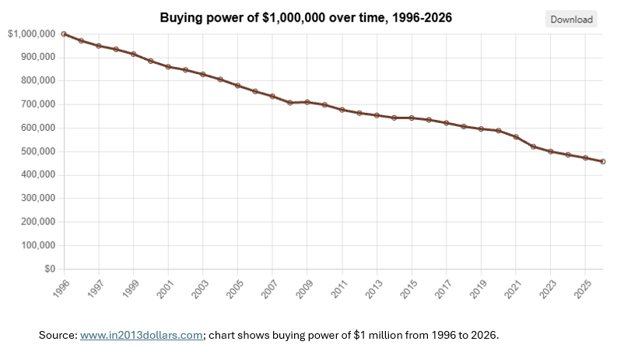
Everyone knows (or at least should know) that inflation erodes purchasing power over time. If everyone knows that, why do we psychologically focus on short term volatility concerns over solving for purchasing power erosion? Consider someone who retired in 1996 with $1 million. Today that same $1 million buys roughly $457,000 worth of “stuff.” No crash did that. There was no bad quarter to point to and no panicked phone call to the advisor — just thirty years of ordinary inflation taking half. My guess is that the loss arrives too slowly to feel like a loss. That doesn’t make it any smaller.
Focusing on real returns
“Real returns” adjust nominal returns for inflation. Net out the tax cost of owning the security — a taxable bond, for example — and you arrive at a return that accounts for both of investing’s quietest costs.
This leads us to one of the biggest dilemmas that investors have with asset allocation, specifically with owning bonds. Over the course of time, government bonds have traditionally struggled with the impacts of both inflation and taxes.
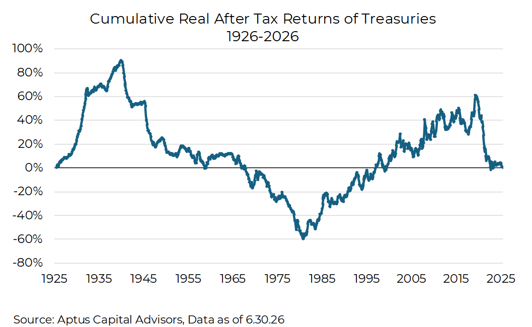
This raises an uncomfortable question: what should investors do when the primary tool for managing portfolio volatility is also the tool creating their long-term purchasing power problem?
Addressing through asset allocation
Let me first caveat all of this by saying one’s risk tolerance should be a combination of one’s willingness (how they feel) and ability (the financial plan) to take risk. It’s not always the right decision to solve for long-term real returns when other considerations are in play, such as a short time horizon and severe anxiety over fluctuations in account values. Despite what my two kids think, sleeping soundly at night matters.
With that said, Jeremy Siegel did a lot of this work for us in his book Stocks for the Long Run. The following graphic shows his findings over multiple centuries. The short answer is that stocks have done a lot of the heavy lifting to assist investors in dealing with the potential for purchasing power erosion.
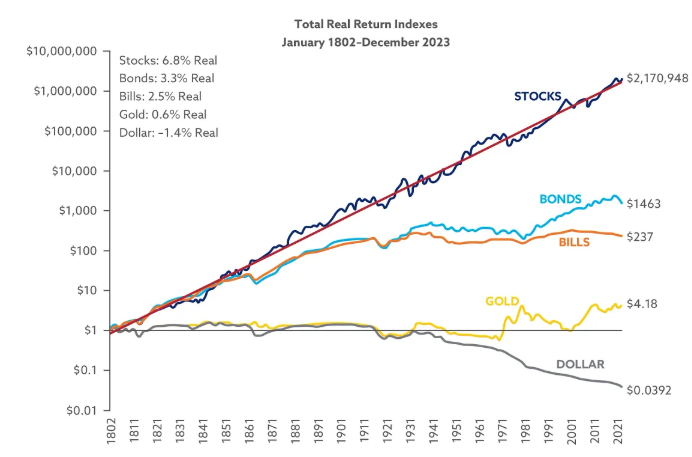
Source: Jeremy J. Siegel, Stocks for the Long Run: The Definitive Guide to Financial Market Returns and Long-Term Investment Strategies
This is why we spend so much time with clients on asset allocation. Whether the issue is excess cash on the sidelines or an overly conservative retirement portfolio, we believe some of the worry we spend on short-term volatility is better spent on inflation. The last five years reminded all of us how quickly it compounds. The graphic below illustrates how modest adjustments to an allocation may improve the odds that a portfolio holds its purchasing power over time.
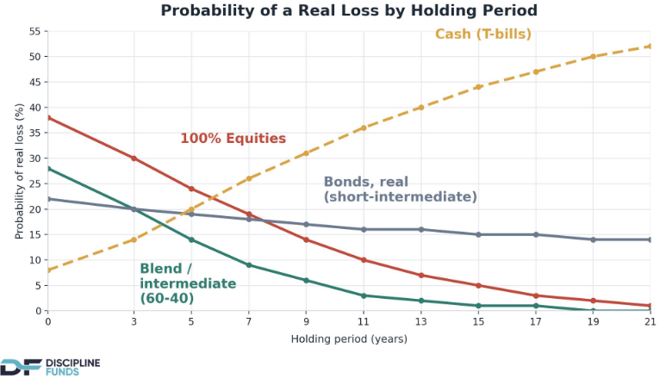
Ignoring the short-term volatility that comes with owning equities is difficult, but the financial plan may be better off for it. Sometimes the risk no one is talking about is the one that matters most.